
Building owners often ask, “Do I need a fire sprinkler system, a fire hydrant system, or both?” It’s a fair question because the two look similar on a drawing (pipes, pumps and water) but they do very different jobs.
This guide explains how each system works, where they differ, and how to decide what your building needs.
What Is a Fire Hydrant System?
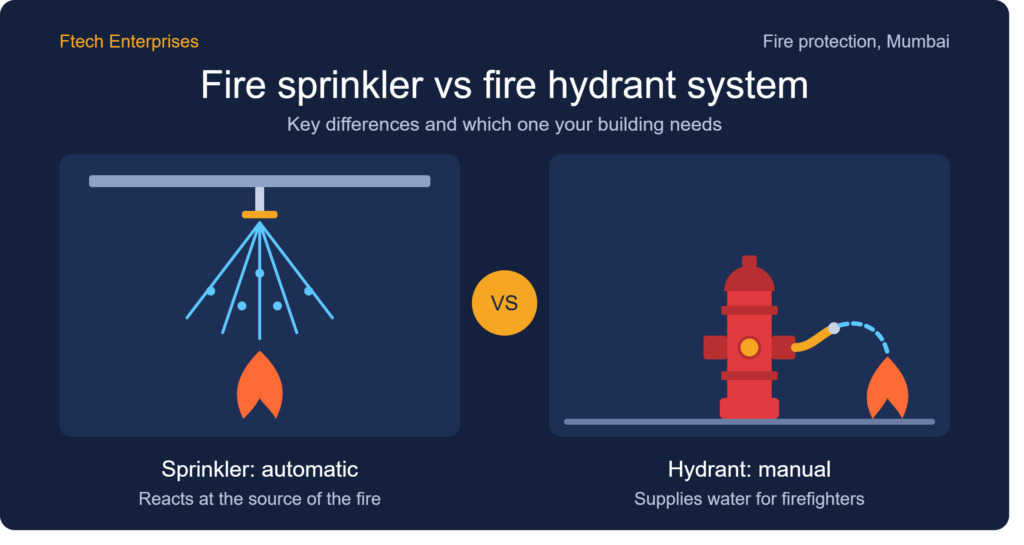
A fire hydrant system is a network of pipes, valves, hydrant points and hoses that supplies water for firefighting. It is a manual system. Someone, either trained staff or the fire brigade, has to connect a hose, open the valve and direct the water at the fire.
It typically includes:
- A water storage tank and fire pumps (main, jockey and standby)
- Pipework, landing valves and hose reels or hose boxes
- Internal hydrants on each floor and external (yard) hydrants around the premises
Hydrants are strong on reach and volume. They support firefighters once a fire has grown, and they cover large outdoor areas such as factory yards and tank farms. To see how the different setups work, read our guide to types of fire hydrant systems and their uses in fire protection.
What Is a Fire Sprinkler System?
A fire sprinkler system is an automatic system. Sprinkler heads are fitted across the ceiling, and each head opens on its own when the heat around it reaches a preset temperature. Only the heads near the fire activate, so water goes where it’s needed, and it starts working without waiting for anyone to arrive.
The main benefit is speed. A sprinkler works in the early stage of a fire, often controlling or extinguishing it before it spreads. It also protects your building when it is empty, such as at night or over a weekend.
Sprinkler vs Hydrant: Side-by-Side Comparison
| Feature | Fire Sprinkler System | Fire Hydrant System |
|---|---|---|
| Operation | Automatic | Manual |
| Response | Immediate, at the point of fire | Depends on people reaching and operating it |
| Best for | Early fire control indoors | Firefighting support, large or outdoor areas |
| Works when building is empty | Yes | No, needs someone to operate it |
| Water delivery | Targeted at heads near the fire | High volume, directed by the user |
| Main components | Sprinkler heads, alarm valves, pumps, piping | Hydrant valves, hoses, pumps, yard hydrants |
| Typical standards | NFPA 13, NBC | NFPA 14 / NFPA 24, NBC |
Which System Do You Need?
For most commercial and industrial buildings, the answer is both. They complement each other: sprinklers handle the early fire, and hydrants support the fire brigade if it grows.
Your requirement depends on:
- Occupancy type (warehouse, factory, office, hospital, mall, residential)
- Building height and area
- Stored materials and fire load
- Local regulations (the National Building Code (NBC) and Maharashtra fire norms) and your insurer’s requirements
Your fire consultant or licensed agency should confirm exactly what applies to your property.
Special Cases: Warehouses, Factories and Server Rooms
- Warehouses: Tall racking and high-piled storage make fires spread quickly. These often need carefully designed sprinkler layouts, sometimes with specialised heads or in-rack sprinklers, plus hydrants around the perimeter.
- Factories with flammable liquids or chemicals: Water alone may not be enough. A foam system may be needed alongside sprinklers and hydrants.
- Server rooms and electrical panels: Water is unsuitable here, so gas-based fire suppression is the usual solution.
Can a Sprinkler System Replace a Hydrant System?
Generally, no. Sprinklers control fire inside the protected area, but hydrants give the fire brigade water access for large or developing fires and for outdoor areas. Codes usually expect both where the building type and size call for it, so check your requirements before assuming one can stand in for the other.
Common Mistakes to Avoid
- Installing only hydrants and relying on staff to respond in time
- Undersized pumps or water tanks that can’t support the design demand
- Blocking sprinkler heads with stored goods or racking
- Changing warehouse layout or storage height without re-checking sprinkler coverage
- Skipping regular testing, since even the best system fails when it isn’t maintained
Why Choose Ftech Enterprises?
Ftech Enterprises Pvt. Ltd. is an ISO 9001:2015 certified fire protection company. We design, supply, install, test and commission fire protection systems as per IS Standards, NFPA and FM Global. Our team can assess your building, recommend the right combination of systems, and maintain them afterwards under an AMC. Learn more about our fire sprinkler system services.
Not sure what your building needs? Contact Ftech Enterprises for a free consultation and site assessment.
FAQs
Is a sprinkler system better than a hydrant system?
Neither is “better.” Sprinklers respond automatically at the source of a fire, while hydrants supply water for firefighting. Most buildings need both.
Do sprinklers all go off at once?
No. Each head reacts individually to heat, so typically only the heads near the fire open.
Do sprinklers cause a lot of water damage?
Far less than an uncontrolled fire. Only heads near the fire activate, and sprinklers usually keep the fire small.
Who decides which systems my building must have?
The requirement follows the NBC, Maharashtra fire regulations and your building’s occupancy. A fire consultant or licensed agency can confirm it for your property.